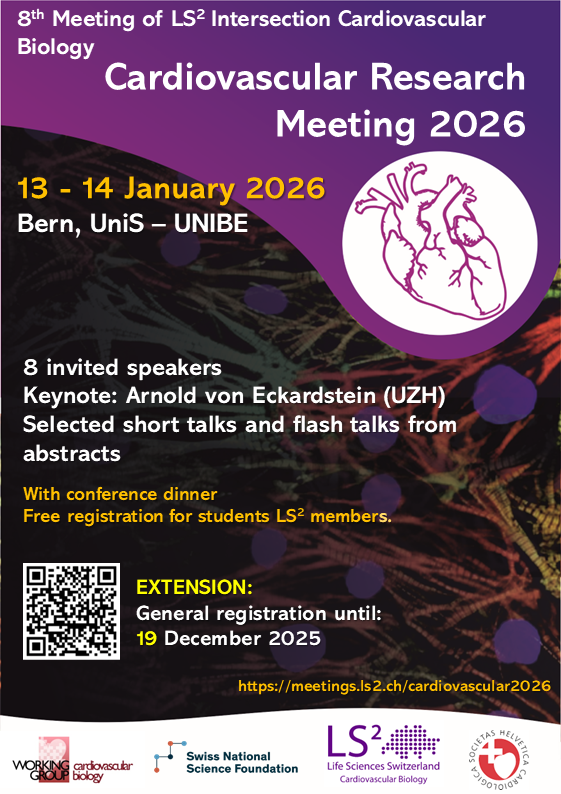
Keynote: Arnold von Eckardstein (University of Zurich, CH)
Main focus: Structure, function, metabolism, and clinical importance of high density lipoproteins (HDL) . Transendothelial lipoprotein transport
Bio: Arnold von Eckardstein studied medicine in Giessen and Kiel and then specialized in laboratory medicine and clinical chemistry in Frankfurt and Münster (Germany). From 2001 to 2025 he was professor at the medical faculty of the University of Zurich and the director of the Institute of Clinical Chemistry of the University Hospital of Zurich (Switzerland; http://www.en.ikc.usz.ch/Pages/default.aspx). His main research interests include risk factors and biomarkers of cardiovascular and metabolic diseases as well as structure, function, and metabolism of high density lipoproteins (HDL) and sphingolipids. He has published more than 500 publications in international peer reviewed scientific journals. Previously, he served as the Editor-in-Chief of Atherosclerosis and as the Chairman of the European Lipoprotein Club, the Swiss and German Atherosclerosis Societies, and the Swiss Society of Clinical Chemistry as well as the Secretary of the European Atherosclerosis Society. He still serves as the Editorial Board Member of BBA Molecular and Cell Biology of Lipids; Cardiovascular Research, and European Heart Journal.
Antonio Zaza (Università degli studi di Milano, IT)
Main focus: Cardiac electrophysiology, arrhythmias, heart failure
Bio: Antonio Zaza graduated in Medicine in 1981 and was board certified in Cardiology in 1984. He was Postdoctoral research scientist in Pharmacology at Columbia University Medical School, New York, NY in 1986-88 He was Assistant Professor in Physiology at University of Milan 1990-1998 and at University Milano-Bicocca 1998-2000 He became Full Professor of Physiology at University Milano-Bicocca in 2000, where he currently chairs the post-graduate school in Sports Medicine In 2004-2006 he chaired the European Working Group of Cardiac Cellular Electrophysiology (EWGCCE) of which he is currently a member of the Nucleus In 2016-2017 he held the Hein J Wellens Visiting Professorship in Cardiology at CARIM- Maastricht University (NL) He is currently Deputy Editor for Basic Science of Europace and Associate Editor of Frontiers in Arrhythmias His field of work is cardiac cellular pathophysiology with a focus on the interaction between intracellular calcium dynamics and repolarization.
Dario Diviani (University of Lausanne, CH)
Main focus: Our research focuses on how compartment-specific signaling complexes provide spatiotemporal control over cellular responses that drive cardiac remodeling and repair.
Bio:
2020-2024 Co-Director, Department of Biomedical Sciences of the University of Lausanne - Switzerland
2018-2019 Director, Department of Pharmacology and Toxicology of the University of Lausanne – Switzerland
2014 Associate Professor, Department of Pharmacology and Toxicology of the University of Lausanne – Switzerland
2008-2014 Tenure track Assistant Professor, Department of Pharmacology and Toxicology of the University of Lausanne
2002-2008 Group leader, Department of Pharmacology and Toxicology of the University of Lausanne - Switzerland
1998-2002 Postdoctoral fellow and Howard Hughes Medical Institute associate, Vollum Institute, Portland - Oregon, USA
1998: Ph.D degree, Department of Pharmacology and Toxicology of the University of Lausanne, Switzerland
Gemma Vilahur (Research Instiute Sant Pau, Hospital de la Santa Creu i Sant Pau Hospital, ES)
Main focus: Ischemic heart disease, lipids, metabolic abnormalities, cardioprotection, heart failure
Bio: Dr. Vilahur is the Director of the Cardiovascular Diseases Area, Head of the Molecular Pathology and Therapeutics of Atherothrombotic Ischemic Diseases Group at the Research Institute of the Hospital de la Santa Creu i Sant Pau, Barcelona, and Group Leader of the CIBERCV-CB16/11/00411 group. Dr. Vilahur is the author of 220 articles (PubMed) and 335 articles (Medline) in prestigious cardiovascular journals (H-index = 52), which include original manuscripts, reviews, and contributions to position papers. She has been and is the principal or co-investigator of over 70 research projects (National and European projects, well-funded by public or private entities). As a result of her research, she has received multiple Awards and Scientific Grants, including Young Researcher Awards granted by the European Society of Cardiology, the American Heart Association , the Spanish Society of Cardiology , the Spanish Society of Atherosclerosis, and the European Society for Clinical Research. Notably, she received the L'Oréal-UNESCO for Women in Science Award and the Award for a Scientific Career of Excellence from the European Society of Cardiology. She has extensive experience in coronary ischemic disease, from atherosclerosis and its cardiovascular risk factors to thrombosis and acute myocardial infarction, as well as identifying new targets/therapeutic strategies to prevent and treat myocardial infarction and subsequent development of heart failure. It is worth mentioning that she is the author of 4 patents and co-founder of 3 spin-offs (see below). As per positions of trust, Dr. Vilahur is the current President of the European Society for Clinical Investigation, past president of the Thrombosis Working Group of the European Society of Cardiology, the current Treasurer of the Working Group on Atherosclerosis and Vascular Biology of the European Society of Cardiology, and is the Leader of the working group in Immunometabolism for the European EU-COST MetaHEART action.
Marco Bacigaluppi (University of Zurich, CH)
Main focus: Our research focuses on translational approaches to elucidate immune-mediated mechanisms driving stroke pathology in the context of frailty-associated conditions. Specifically, we investigate how these states alter immune-pathophysiological processes and contribute to cerebrovascular dysfunction and thrombotic risk.
Bio: Prof. Marco Bacigaluppi works as SNSF Assistant Professor at the Center for Molecular Cardiology since May 2025. Dr. Bacigaluppi earned his medical degree from the Vita-Salute San Raffaele University in Milan in 2004. He then specialized in Neurology in 2009, and subsequently completed a PhD in Molecular Medicine at the same institution, with a strong focus on pathophysiological mechanisms in ischemic stroke. During this time, he also worked as a neurologist at San Raffaele Hospital, in the department led by Prof. Giancarlo Comi, focusing on ischemic stroke.
From 2016 to 2024, Dr. Marco Bacigaluppi worked as a physician-scientist, combining clinical practice in the Stroke Unit with translational research on inflammation in both experimental and clinical stroke. He initiated observational studies on thrombosis and immune mechanisms, with a particular focus on thrombus pathology. In 2024, he was awarded the prestigious SNSF Starting Grant to establish an independent research group focused on the interaction between immune cells and thrombosis at the Center for Molecular Cardiology.
Nina Cabezas-Wallscheid (ETH Zurich, CH)
Main focus: Regulation of hematopoietic stem cells
Bio: Prof. Dr. Nina Cabezas-Wallscheid was appointed in 2023 as full professor at the ETH Zürich (Switzerland). Dr. Cabezas-Wallscheid started her group at the Max Planck Institute of Immunobiology and Epigenetics in Freiburg (Germany) in 2017. Her group studies how hematopoietic stem cell dormancy is regulated in healthy and in the context of hematological, nutritional disorders and aging. Her laboratory is pursuing interdisciplinary projects that include the use of genetic mouse models, dietary treatments and primary human patient material in combination with the development of state-of-the-art omics, single-cell techniques and bioinformatic analysis. Prof. Cabezas-Wallscheid received an ERC Starting Grant in 2017, ERC Consolidator in 2023 and is part of the EMBO Young Investigator Program since 2022. She was honored with the German Stem Cell Network 2018 Young Investigator Award and the Janet Rowley Award by the International Society of Experimental Hematology in 2023. Prof. Cabezas-Wallscheid conducted her postdoctoral work in the laboratory of Prof. Andreas Trumpp at the German Cancer Research Center in Heidelberg (Germany). She gained her PhD at the Medical Center of Mainz under the supervision of Dr. Ernesto Bockamp and studied biotechnology (MSc) at the Autonomous University of Barcelona, Spain, and the University of Parma, Italy.
Tatiana Petrova (Department of Oncology UNIL – CHUV, Ludwig Institute for Cancer Research Lausanne, CH)
Main focus: Vascular specialization in homeostasis and cancer
Bio: Tatiana Petrova obtained her diploma in chemistry from Moscow State University and her PhD in biochemistry from University of Geneva Following postdoctoral training at Northwestern University in Chicago and Biomedicum Helsinkishe established her group at Biomedicum Helsinki in 2004. Since 2008 she leads a group of Vascular and Tumor Biology at the University of Lausanne, Switzerland.
The research of Tatiana Petrova’s group focuses on organ- and disease-specific functions of mammalian blood and lymphatic vessels. Current systems of interest include intestine, lymphoid organs, adipose tissue and colorectal cancer.
Niels Riksen (Radboud University Medical Center, NL)
Main focus: Translational innate immunity in atherosclerosis
Bio: Since 2014, Niels Riksen is a full professor of Vascular Medicine and head of the Division of Vascular Medicine at the Radboud University Medical Centre in Nijmegen, the Netherlands.
He completed a PhD in 2007 on clinical pharmacology and ischemia-reperfusion injury and a postdoc period in the Hatter Cardiovascular Institute in London on myocardial ischemia-reperfusion injury. He was registered as an internist and specialist in vascular medicine in 2010 and became Head of Department of Vascular Medicine of the Radboud University Medical Center in 2012. In 2014 he was appointed full professor of Vascular Medicine. His research focuses on elucidating the role of innate immune cell reprogramming in development of atherosclerosis.
Sean Davidson (University College London, UK)
Main focus: How to protect the heart from cardiac ischaemia and reperfusion injury.
Bio: Professor Davidson obtained his PhD in Melbourne, Australia, then moved to Paris for a postdoctoral position, where he conducted research on the development of the heart. He moved to London in 1998 and is now Professor of Cardiovascular Research at the Hatter Cardiovascular Institute at University College London, where he investigates methods to protect the heart from myocardial infarction. A major focus of his interest lies in investigating the PI3Kinase pathway and how it can be harnessed to protect the heart. He is actively involved in the scientific community, and is the current Secretary of the International Society for Heart Research – European Section (ISHR-ES). He is an associate editor of Cardiovascular Research and Cardiovascular Drugs and Therapy, and is on the editorial board of Basic Research in Cardiology.