Preliminary Program
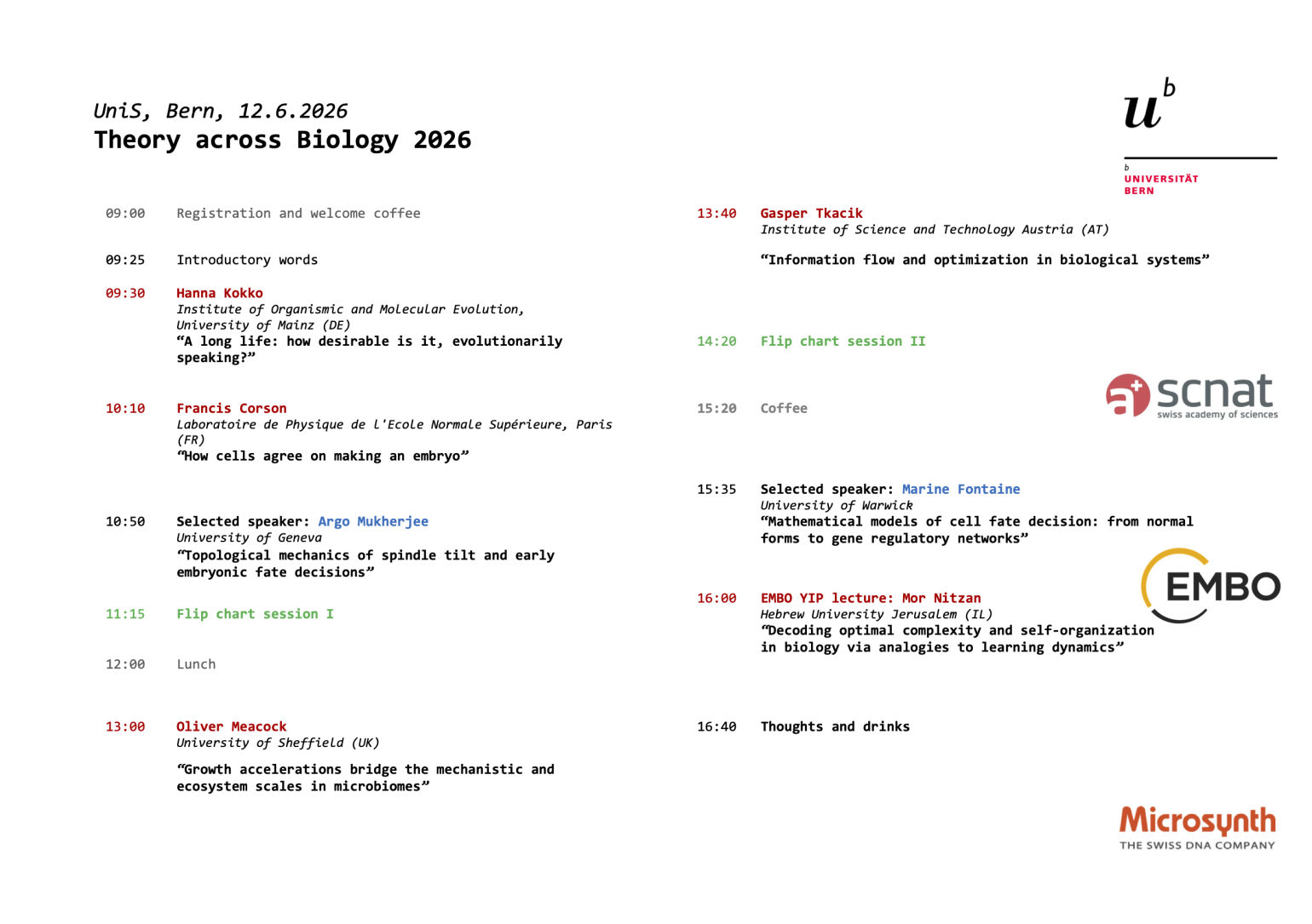
09:00 Registration and welcome coffee
09:25 Introductory words
09:30 Hanna Kokko
Institute of Organismic and Molecular Evolution, University of Mainz (DE)
“A long life: how desirable is it, evolutionarily speaking?”
What does a theoretical biologist do? We try to understand why evolution produces so much diversity. Naively, one might think that if natural selection continually seeks out the ‘best’ solutions, by now one best-performing organism should have emerged. Instead, there is vast diversity, even for characteristics such as lifespan that appear easily arrangeable an axis from worse to better. For every superbly long-lived shark species, there are very many other species of fish that die at a much younger age. I will present two examples of our work on senescence evolution: first, an exploration of the so-called Williams hypothesis, which emphasizes the role of extrinsic (unavoidable) mortality in shaping how ‘robustly’ bodies will be built, and second, a comparative analysis on birds and mammals, showing that birds appear to senesce less than mammals do.
10:10 Francis Corson
Laboratoire de Physique de l'Ecole Normale Supérieure, Paris (FR)
“How cells agree on making an embryo”
During development, an orderly structure progressively emerges as cells acquire more specialized identities and rearrange in space. Much is known about the relevant cellular and molecular processes, but the dynamics by which spatial patterns arise, and the underlying logic, often remain elusive. Drawing on several concrete examples, and a geometric approach to cell fate specification, in the spirit of Waddington's epigenetic landscape, I will discuss some of the ways that cell-cell interactions can support self-organization, and ask whether we should think of the form of an embryo as a consensus among its parts.
10:50 Selected speaker: Argo Mukherjee (University of Geneva)
“Topological mechanics of spindle tilt and early embryonic fate decisions”
11:15 Flip chart session 1
12:00 Lunch
13:00 Oliver Meacock
University of Sheffield (UK)
“Growth accelerations bridge the mechanistic and ecosystem scales in microbiomes”
Microbiomes are ecosystems in miniature. Ecological interactions between microbial populations are generally mediated through their shared chemical environment, for example via competition for shared nutrients or exchange of secreted metabolites. Exactly how such mechanistic processes shape ecosystems is a fundamental question in theoretical ecology, yet a general solution has eluded the field since this problem was first posed over fifty years ago. I will present new results that provide a general link between the mechanistic and ecosystem perspectives by proposing that growth accelerations, rather than rates, are the quantitative basis of microbiome dynamics. Our key result is the derivation of a second-order expression that is algebraically equivalent to the generalised Lotka-Volterra (gLV) equation at equilibrium, but which is constructed out of an explicitly mechanistic description of the ecosystem. This result allows us to apply a large suite of techniques developed to study the gLV equation to mechanistic ecosystem models. Finally, I will show how this result can resolve the apparent contradictory results of theoretical studies, which suggest that cooperation is destabilising, with the widespread observation of cooperative mechanisms in natural microbiomes. Our framework thus provides a flexible bridge between abstract theory and mechanistic reality.
13:40 Gasper Tkacik
Institute of Science and Technology Austria (AT)
“Information flow and optimization in biological systems”
I will give a high-level overview of how information theory can be applied to living systems, both as a descriptive language with which to quantify information flows from data, as well as normative language with which to build predictive theories. I’ll mention applications in gene regulation, organismal development, neural coding, and evolution.
14:20 Flip chart session 2
15:20 Coffee
15:35 Selected speaker: Marine Fontaine (University of Warwick)
“Mathematical models of cell fate decision: from normal forms to gene regulatory networks”
16:00 EMBO YIP lecture
Mor Nitzan
Hebrew University Jerusalem (IL)
“Decoding optimal complexity and self-organization in biology via analogies to learning dynamics”
16:40 Thoughts and drinks
Speakers
|
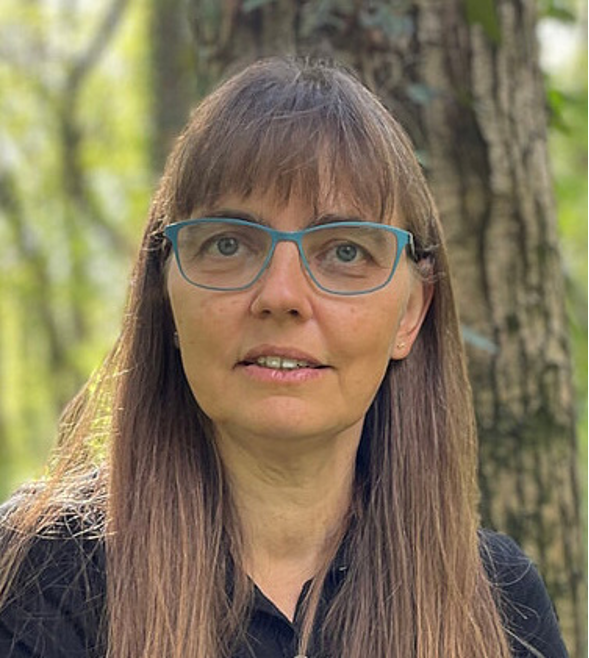
Hanna Koko (Institute of Organismic and Molecular Evolution, |
 |
|
Francis Corson (Laboratoire de Physique de l'Ecole Normale Supérieure, Paris (FR)) Francis Corson is a CNRS research director at the physics department of Ecole Normale Supérieure in Paris. Following a PhD at ENS and a postdoc at the Rockefeller University, he has held CNRS positions at the Pasteur Institute then at ENS. Drawing on his background in nonlinear physics, and on close collaborations with experimentalists, his research aims to develop simple models to illuminate the dynamics of developmental patterning and morphogenesis, with a particular interest for self-organization, explored in such systems as the Drosophila peripheral nervous system and the early amniote embryo.
|
 |
|
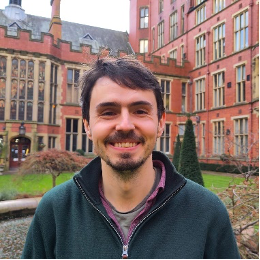
Oliver Meacock (University of Sheffield (UK)) Oliver works at the interface between microbial ecology and physics, including use of bacteria as an experimental model of active matter and development of theory to understand the properties of microbiomes. His main interest at present is understanding how niche-based interaction mechanisms (e.g. cross feeding of metabolites or nutrient competition) shapes emergent community structure in microbial communities. |
 |
|
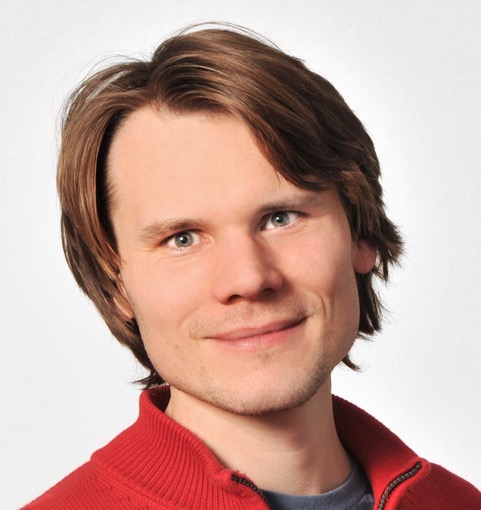
Gasper Tkacik (Institute of Science and Technology Austria (AT)) Gasper Tkacik is a Professor at the Institute of Science and Technology Austria. Gasper obtained his PhD in Physics from Princeton University for his work with William Bialek. His postdoctoral work at the University of Pennsylvania focused on Computational Neuroscience. Gasper is interested in how interacting systems in biology – networks of genes, signaling proteins or neurons, and even whole organisms engaging in collective behaviors – sense, transduce and process internal and environmental signals in order to guide their behavior. On the search for basic principles underlying such “biological computation,” Gasper’s research group uses interdisciplinary approaches grounded in physics, neuroscience, inference, and data analysis. Gasper’s work has been recognized by HFSP and ERC Synergy grants, and the Lieben Prize of the Austrian Academy of Sciences. |
 |
|
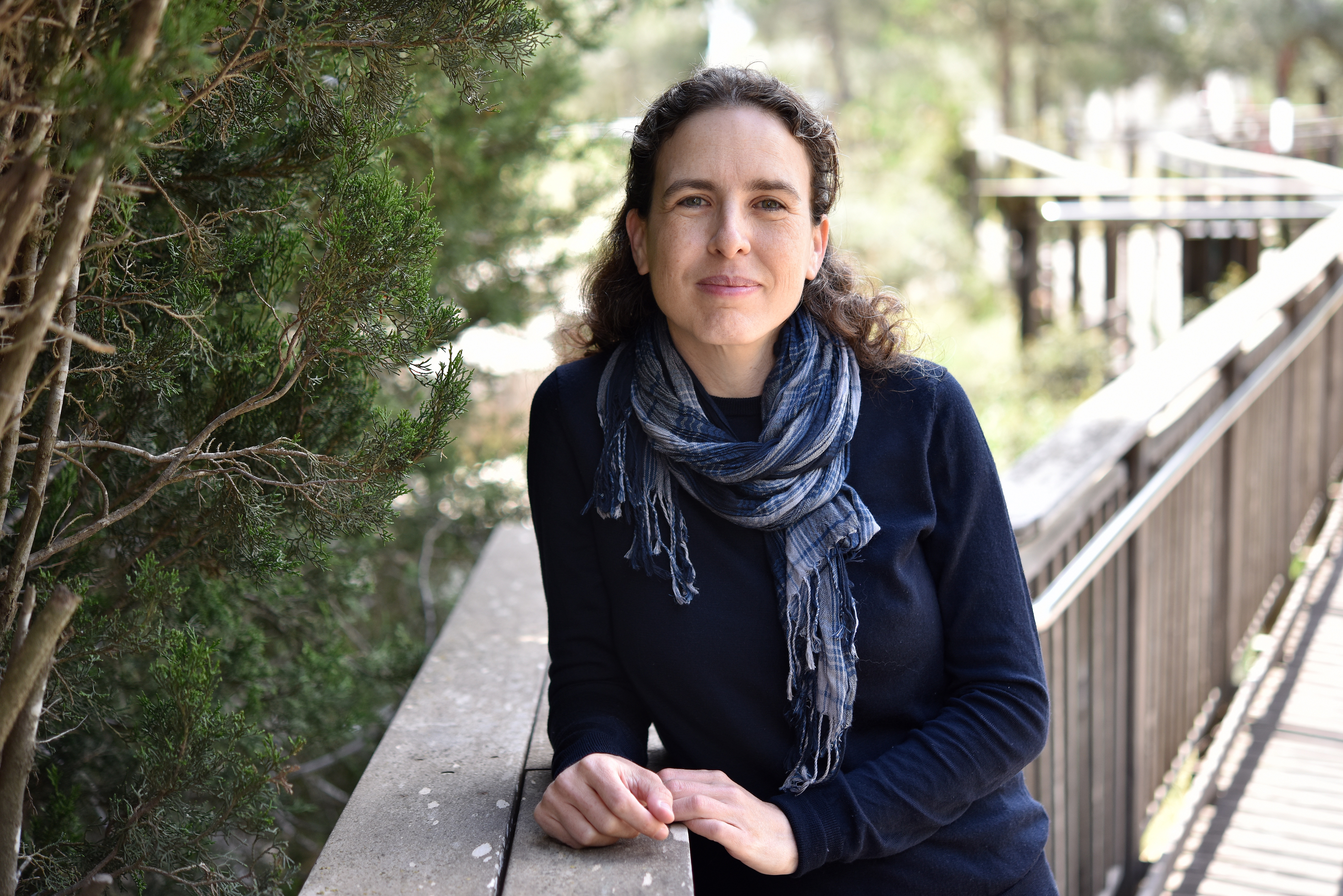
Mor Nitzan (Hebrew University Jerusalem (IL)) Mor Nitzan is an Associate Professor at the Hebrew University of Jerusalem, with joint affiliations at the School of Computer Science and Engineering, Racah Institute of Physics, and The Faculty of Medicine. Previously, she was a John Harvard Distinguished Science Fellow and James S. McDonnell Fellow at Harvard University. She obtained a BSc in Physics, and a PhD in Physics and Computational Biology at the Hebrew University as an Azrieli Sciences Fellow. She is the recipient of the EMBO Young Investigator Award, Krill Award, Azrieli Early Career Faculty Fellowship, Alon Fellowship, Google Research Scholar Award, Samson Researcher Recruitment Award, and an ERC Starting Grant. Prof. Nitzan's research is at the interface of Computer Science, Physics, and Biology, focusing on the representation, inference, and design of multicellular systems. Her group develops computational frameworks to better understand how cells encode multiple layers of spatial and temporal information, and how to efficiently decode that information from single-cell and spatial omics data. They aim to uncover organization principles underlying information processing, computation, division of labor, and self-organization of multicellular structures such as tissues, and how cell-to-cell interactions can be manipulated to optimize tissue structure and function.
|
 |